
GOHA directly led the SEO project for TELOS Academy with a goal beyond increasing traffic — transforming the website into a qualified lead generation channel for Figma, UI/UX, and related training programs. In a highly competitive digital education market, the challenge was not simply “being visible on Google,” but appearing precisely when learners were searching for courses, career roadmaps, and professional direction. Ultimately, conversion and qualified leads were the core business outcomes TELOS Academy expected GOHA to deliver.
1. Background & Challenges
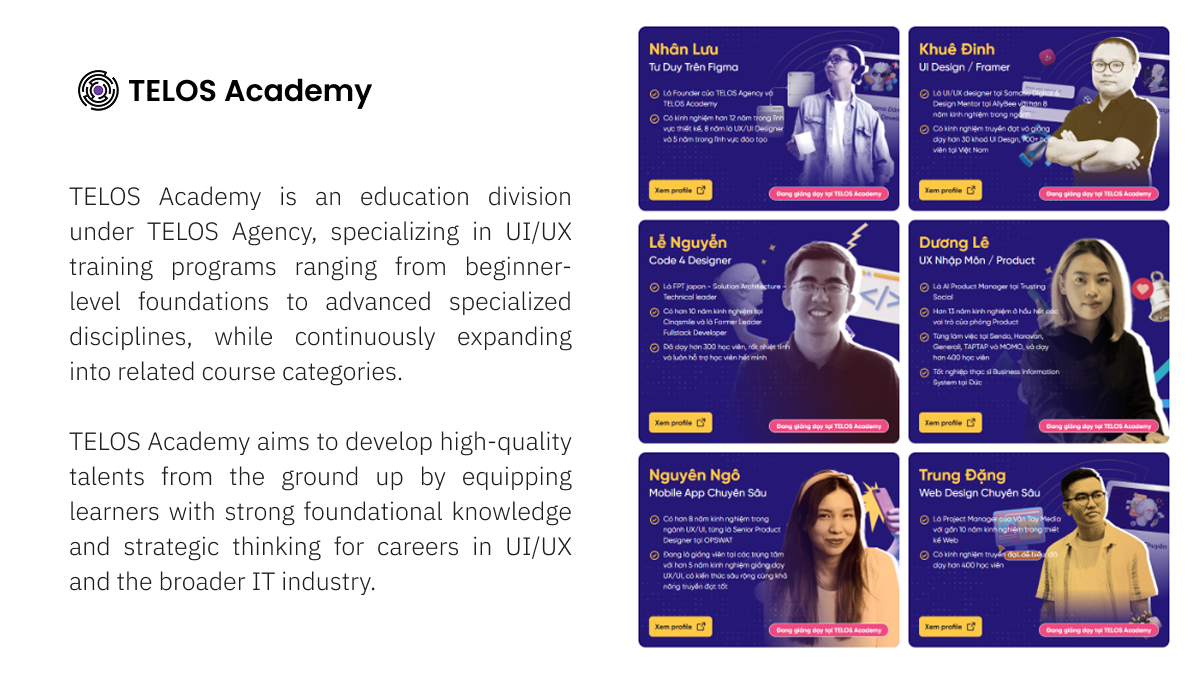
TELOS Academy operates in the highly competitive UI/UX education market, where learners can choose from specialized academies to large-scale edtech brands. At the beginning of the project, TELOS Academy had to compete directly against competitors with significantly stronger traffic, larger organic keyword coverage, and heavier SEO investment.
The challenge for GOHA was not only improving keyword rankings, but also building strong authority for TELOS Academy around two strategic pillars: Figma and UI/UX (and more recently, Product Design). These keyword clusters are highly competitive while also carrying strong conversion intent, as users are typically searching for courses, career paths, or comparing educational options.
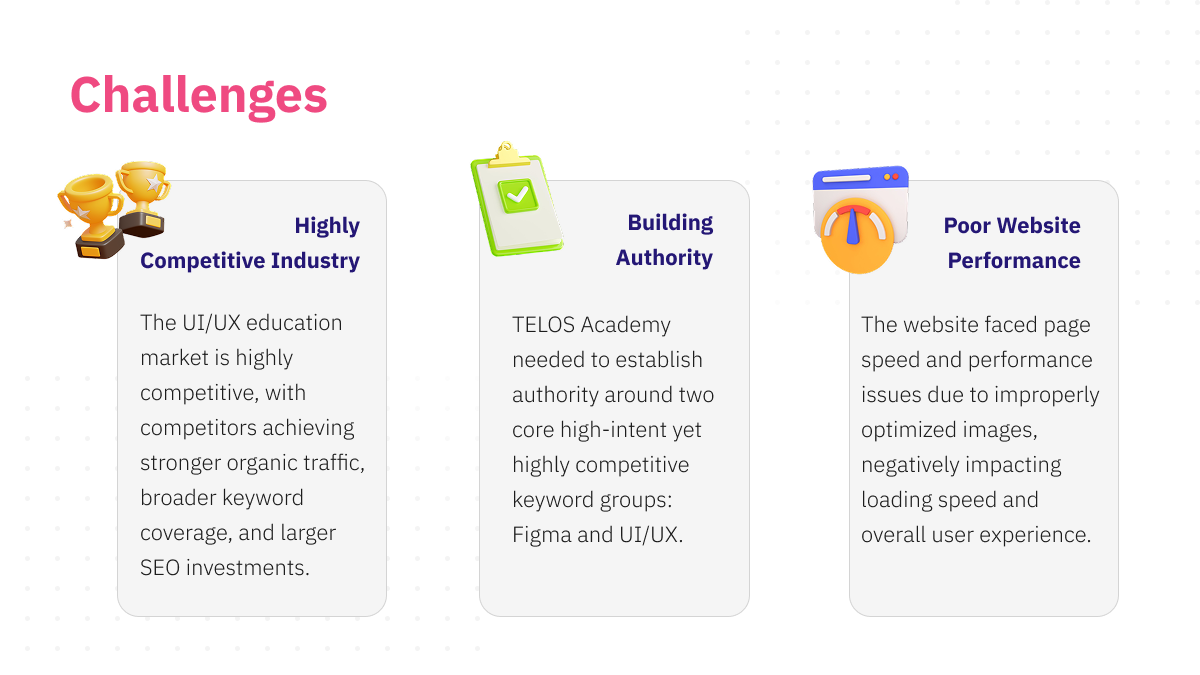
At the same time, the website faced performance bottlenecks. Multiple URLs suffered from poor LCP performance due to unoptimized images, oversized assets, and excessive image usage on course pages. These issues directly impacted user experience, traffic retention, and overall SEO effectiveness.
2. Objectives & KPI Commitments
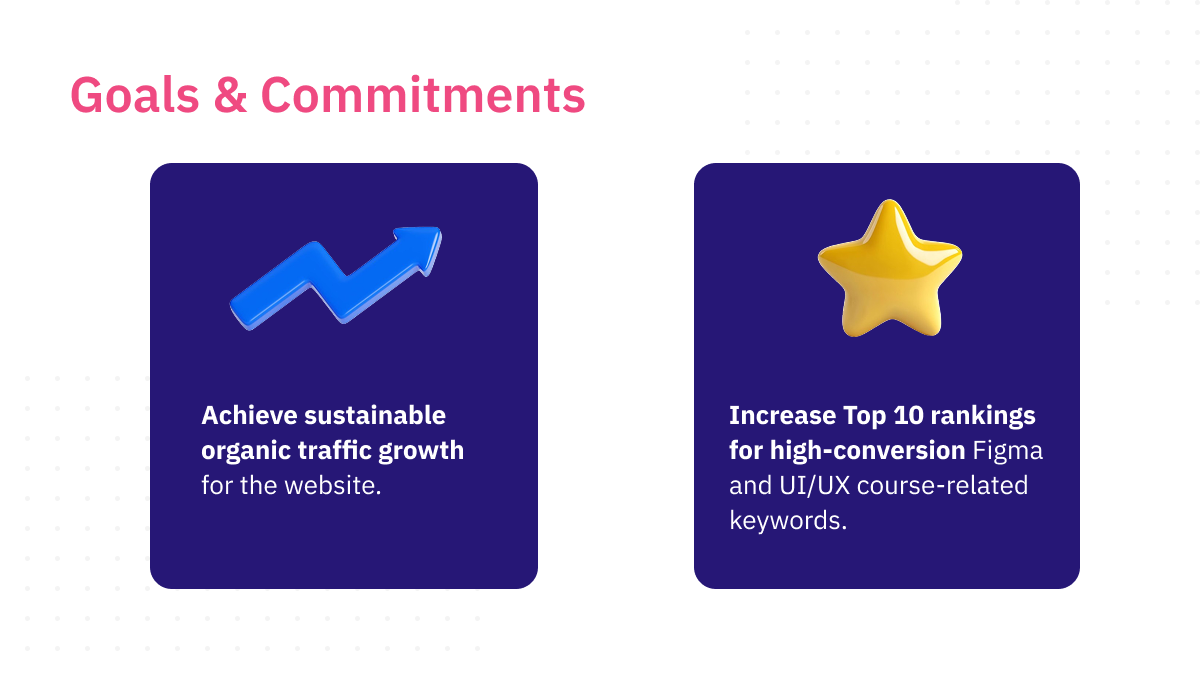
During the project, GOHA and TELOS Academy focused on two core KPI groups:
- Achieve sustainable organic traffic growth for the website
- Increase the number of Top 10 ranking keywords, especially high-conversion keywords related to Figma and UI/UX courses
The project KPI targets included:
- 11,000 organic traffic
- 15 additional high-conversion keywords ranking in the Top 10
These KPIs were ambitious enough to drive meaningful growth while remaining aligned with the website’s actual authority and competitive landscape.
3. GOHA’s SEO Strategy
3.1. Building Authority Around Figma & UI/UX
Instead of expanding broadly, GOHA focused on building authority around two core topics: Figma and UI/UX. The entire content strategy centered on strengthening internal links, increasing link equity, and consolidating topical relevance signals toward these two clusters.
The content ecosystem was developed across multiple search intent layers:
- Course-related keywords: where to learn, best courses, learning roadmap, study materials, salary insights
- Foundational concepts: what is UI/UX, what does a UI/UX Designer do, what is Figma
- Tool comparison keywords: Figma vs Canva, Figma vs Adobe XD
- Related concepts: User Flow, Design System, design thinking, app design software
- Expansion topics: website design, AI, user persona, Framer, and surrounding topics to broaden search visibility
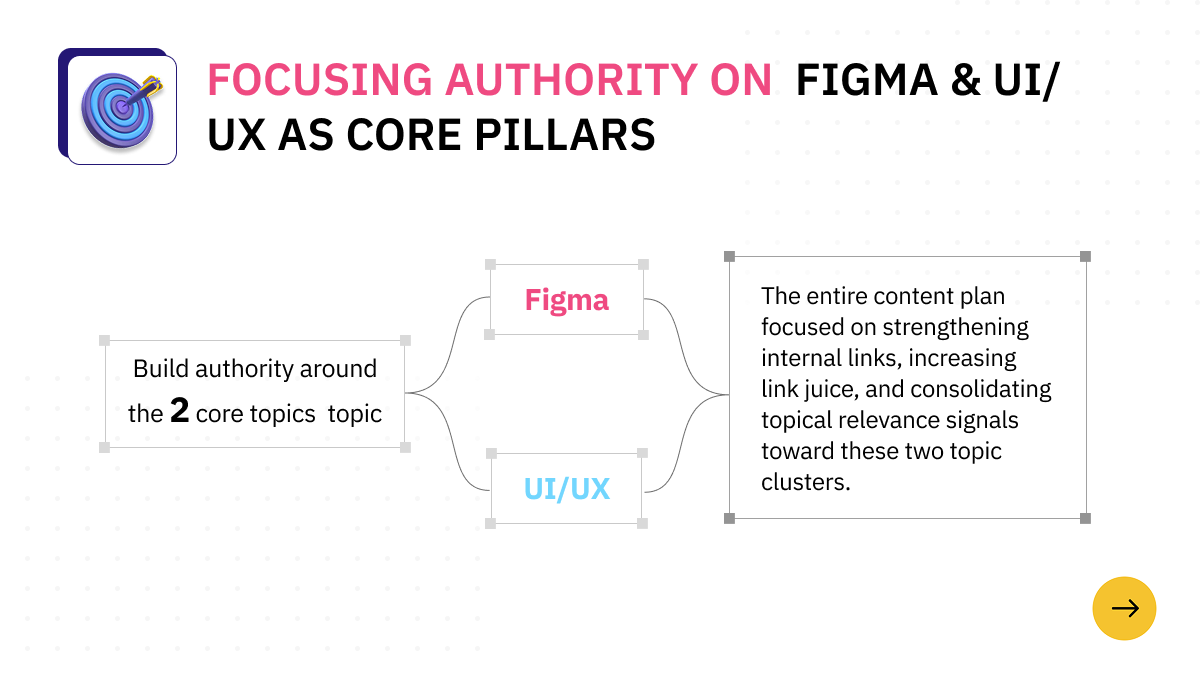
This strategy enabled TELOS Academy not only to increase traffic, but also to gradually position itself as a content authority in the Figma and UI/UX space.
3.2. Content Built Around the Learner Decision Journey
GOHA structured content based on the learner customer journey:
Discovery Stage
Focused on educational content such as:
- “What is UI/UX?”
- “How to start learning UI/UX”
- “What is Figma?”
- “UI/UX salary”
Consideration Stage
Developed content around:
- Learning roadmaps
- Tool comparisons
- Study resources
- Career orientation
Conversion Stage
Strengthened:
- Course pages
- Course landing pages
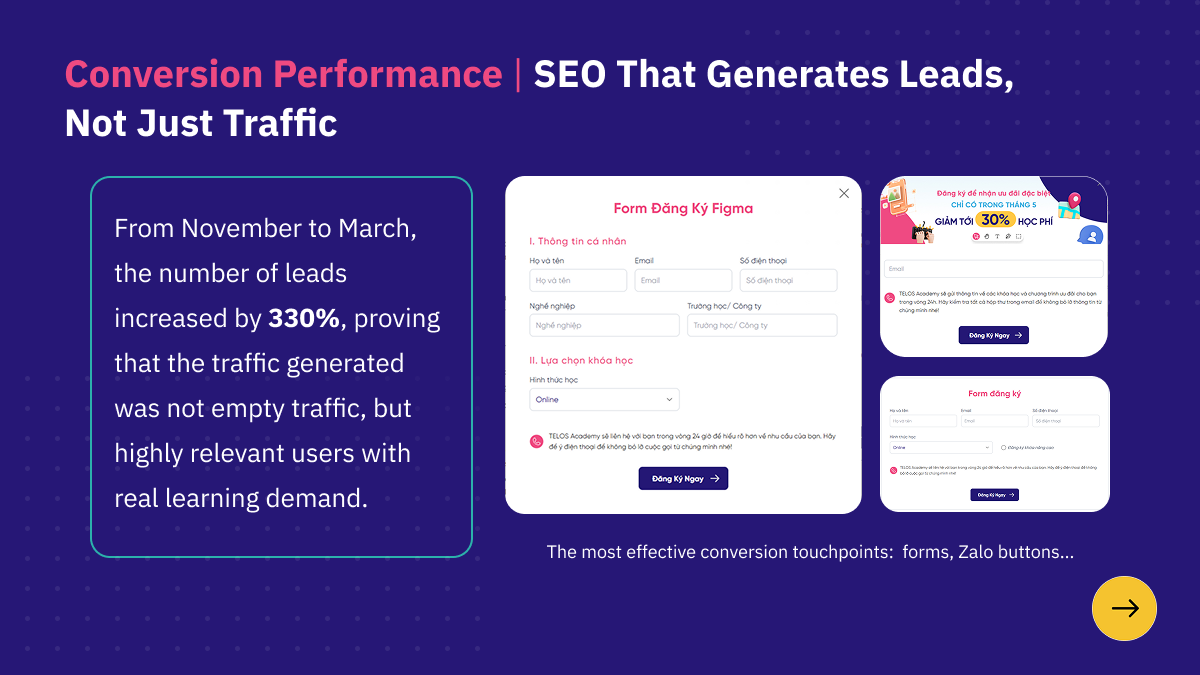
- Registration forms
- Zalo CTAs and lead generation touchpoints
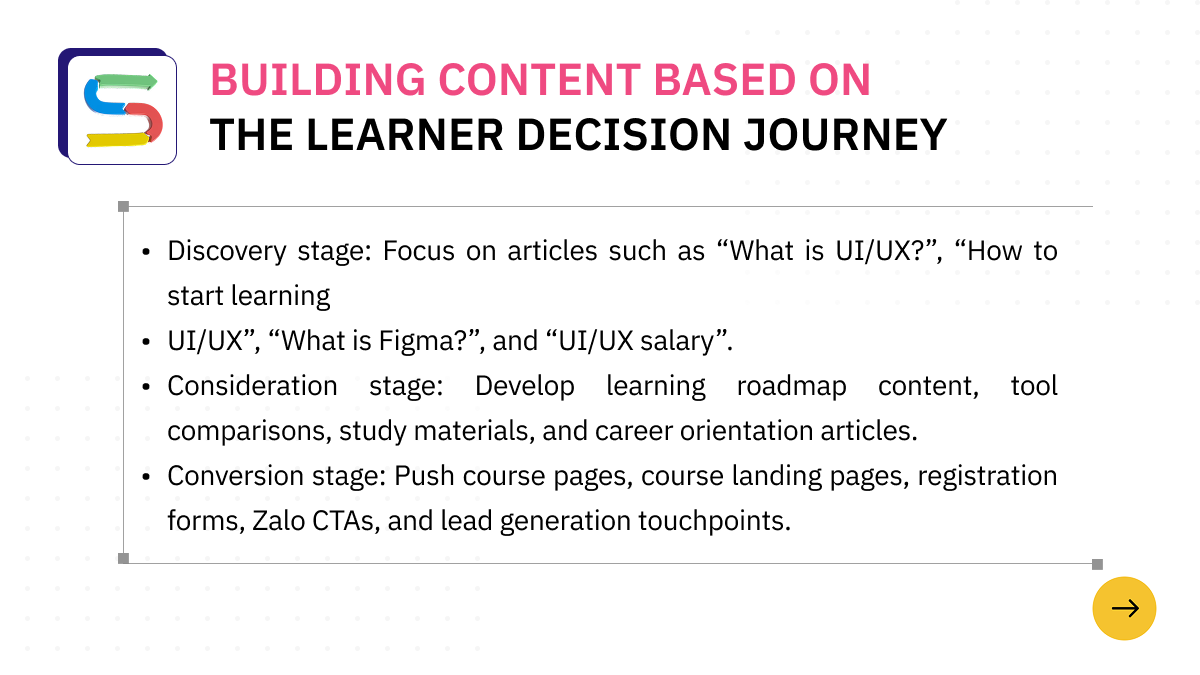
As a result, the website not only attracted top-of-funnel traffic, but also successfully guided users toward high-value conversion points.
3.3. Using Content to Win on Both Google & AI Search
Within GOHA’s strategy, SEO and AEO (Answer Engine Optimization) were not treated as separate directions, but as two optimization layers supporting the same objective: helping the brand appear at the right moment, within the right context, and for the right user intent.
While SEO helped TELOS Academy increase visibility on Google, AEO enabled the brand to become a trusted source referenced by AI platforms when users asked questions about learning UI/UX, career transitions, or choosing the right course.
GOHA therefore optimized content not only for rankings, but also for AI readability, citation potential, and answer extraction. Thanks to highly relevant, in-depth content aligned with search intent, TELOS Academy gradually appeared in AI chatbot responses as a trusted reference source.
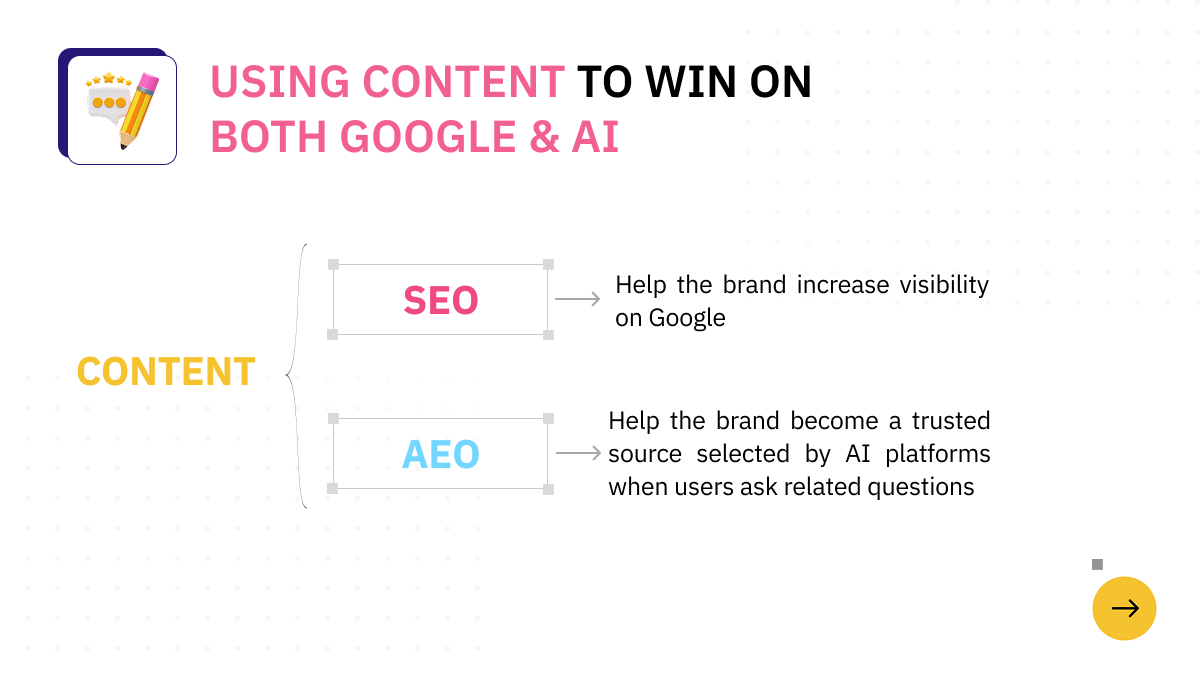
This represents the intersection between SEO and AEO: a strong content strategy not only helps users discover the brand through Google, but also enables AI systems to proactively recommend the brand in the rapidly evolving search landscape.
4. Results Achieved
After implementation, the project exceeded KPIs across both traffic and keyword growth:
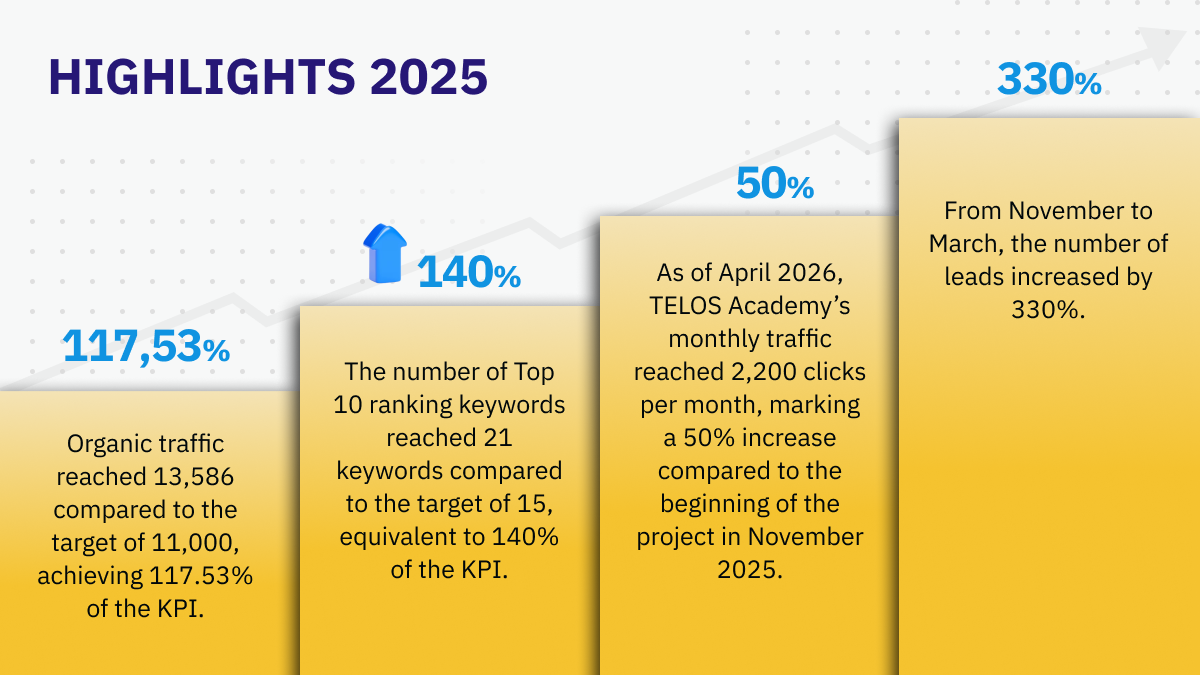
- Organic traffic reached 13,586 compared to the target of 11,000, achieving 117.53% of KPI
- Top 10 ranking keywords increased to 21 keywords compared to the target of 15, achieving 140% of KPI
As of April 2026, TELOS Academy’s monthly traffic reached 2,200 clicks per month, representing a 50% increase compared to the start of the project in November 2025.
Beyond volume growth, ranking quality also improved significantly as many high-conversion course-related keywords entered the Top 5 and Top 10 positions. These keywords carried strong business value because they were directly tied to enrollment intent.
5. Conversion Impact: SEO That Generates Leads, Not Just Traffic
One of the clearest indicators of success was monthly lead growth. From November to March, the number of leads increased by 330%, proving that the traffic generated was not empty traffic, but highly relevant users with real learning demand.
The highest-performing conversion touchpoints included:
- Zalo button clicks
- Course registration forms
- Blog forms
- Learning roadmap forms
Among these, Zalo and course registration forms demonstrated the strongest conversion performance. Notably, March recorded a CTR of 65%, contributing directly to revenue growth for the academy.
This marked a major shift: SEO was no longer serving only as a brand visibility channel, but as a direct contributor to enrollment performance.
6. Competitive Performance: Strong Growth Despite a Lower Starting Point
Compared to competitors such as Keyframe, DAS, and MindX, TELOS Academy started with lower overall website traffic. However, the key difference was growth velocity.
While many competitors experienced slow growth or traffic decline following Google algorithm updates, TELOS Academy still achieved approximately 50% traffic growth compared to the beginning of the project. Keyframe grew by only around 20%, while DAS and MindX recorded downward trends.
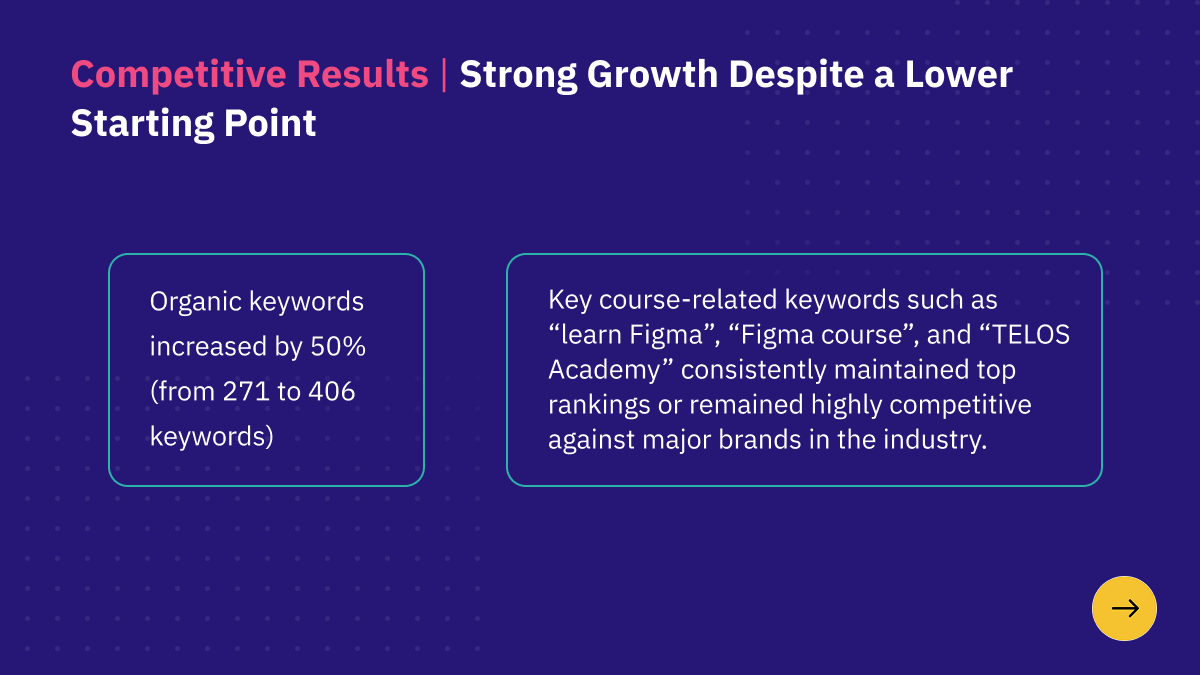
In terms of organic keywords, TELOS Academy increased from 271 to 406 keywords — a 50% increase. This was particularly notable in a market where many competitors remained stagnant.
GOHA considered this a strong validation that the topical authority strategy was moving in the right direction.
For important high-conversion keywords such as:
- “learn Figma”
- “Figma course”
- “UI/UX course”
- “learn UI/UX”
- “AI UI/UX course”
- “UI/UX learning roadmap”
TELOS Academy consistently maintained leading positions or remained highly competitive against major brands in the market.
7. AI Chatbot Visibility: A New Growth Layer
Beyond Google Search, TELOS Academy also appeared across multiple AI chatbot platforms for highly conversion-oriented prompts such as:
- “Where is the best place to learn UI/UX?”
- “I want to switch careers from Graphic Designer to UI/UX Designer — where should I study?”
Appearing on ChatGPT, Google AI Mode, Perplexity, and Gemini demonstrates that TELOS Academy is building a new layer of brand visibility — not just as a website with rankings, but as a trusted source referenced by AI when responding to users.
This is especially valuable in education, where enrollment decisions are heavily influenced by trust, brand recognition, and perceived expertise.
8. A Content System That Drives Real Growth
One of the project’s biggest achievements was the emergence of multiple articles as top-performing traffic pages on the website.
High-performing content included:
- How to register for free Figma Education
- Beginner’s guide to using Figma
- UI/UX & Product Designer salary report in Vietnam
- User Flow in digital product experiences
- Popular Design System templates for designers
- Product Designer vs UI/UX Designer
- Figma PDF learning materials for beginners
- Roadmap to becoming a UX/UI Designer
- AI in Figma
- App design principles for iOS and Android
Importantly, this content ecosystem was not dependent on a single content format. It combined tutorials, definitions, comparisons, career-oriented content, and trend-driven topics.
As a result, the website simultaneously increased top-of-funnel traffic, nurtured learning demand, and guided users toward course pages.
9. What Value Did GOHA Create for TELOS Academy?
In this project, GOHA focused on delivering four core layers of value:
- Building authority for TELOS Academy around the strategic clusters of Figma and UI/UX
- Driving sustainable traffic growth through content aligned with real search behavior
- Ranking high-conversion keywords to directly support student enrollment
- Expanding brand visibility beyond Google into AI chatbot conversations
The final outcome was that TELOS Academy not only exceeded traffic and keyword KPIs, but also achieved significant lead growth, strengthened its position within the digital design education market, and built a scalable foundation for future expansion.


